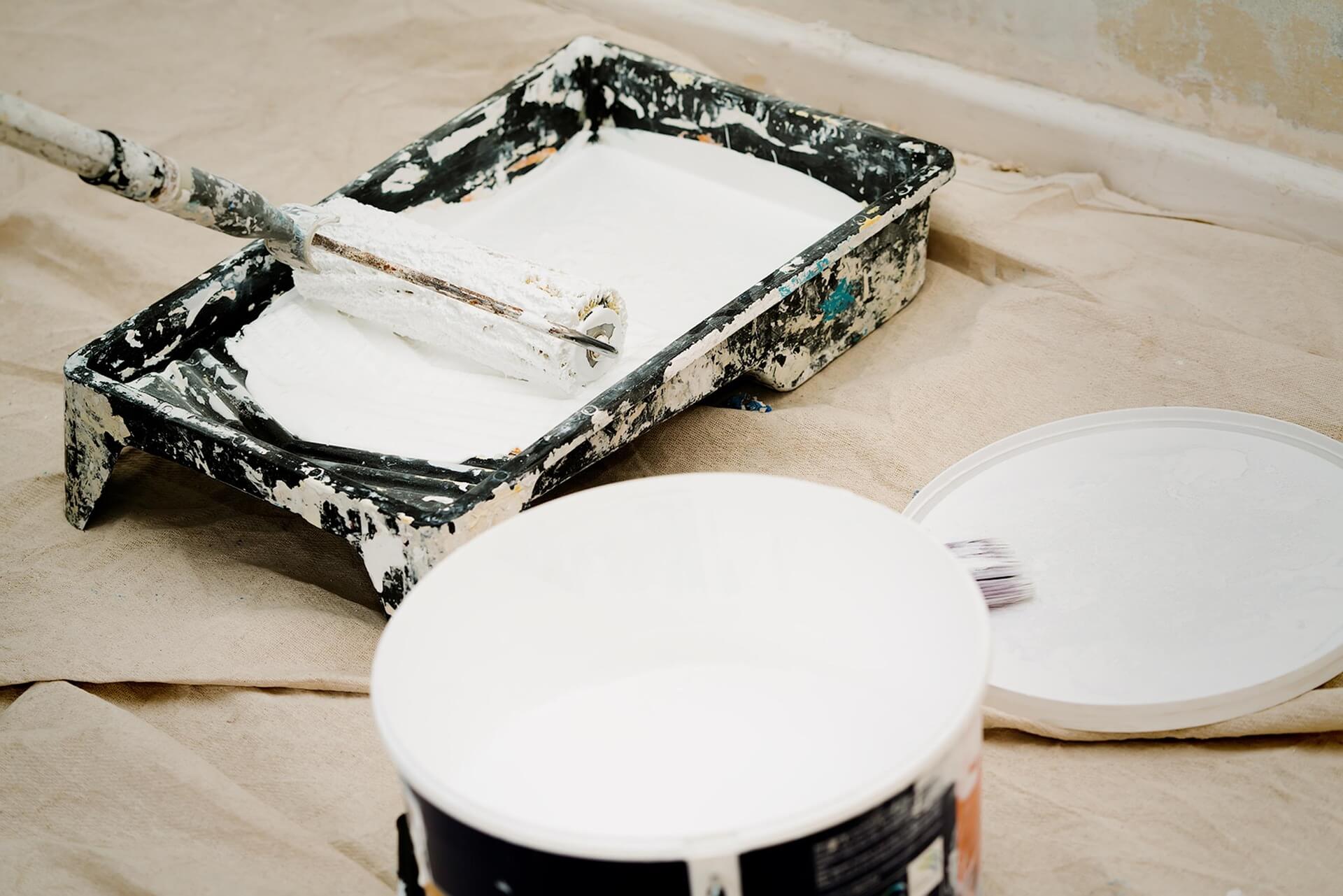
Estimate exterior paint for siding, trim, and exterior walls. Get results in gallons, liters, and total cost.
Exterior Paint Estimator
FREE
ft
ft
ft
ft²/gal
$
📊 Paint Results
Total Paint Needed
0.00
Gallons
Liters
0.00
L
Total Wall Area
0.00
sq ft
Estimated Cost
$0.00
Total
Gallons per Coat
0.00
Cans Needed
0
(1 gal cans)
Coverage Used
0
ft²/gal
💡 Pro Tip: Always buy 10-15% extra paint for touch-ups and waste. For textured surfaces, coverage may be lower — adjust the coverage value accordingly.
📋 Quick Guide: 1 Gallon Covers
Smooth Wall
350–400
sq ft
Textured Wall
250–300
sq ft
Ceiling
300–350
sq ft
Trim
400–500
sq ft
📐 Paint Coverage Guide
Surface
ft² per Gallon
Smooth walls (drywall)
350–400
Textured walls
250–300
Ceilings
300–350
Trim & baseboards
400–500
Exterior siding
250–350
Coverage varies by paint quality, surface texture, and application method.
🖌️ Common Room Paint Estimates
Room Size
Walls (2 coats)
+ Ceiling
10' × 10'
1–1.5 gal
1.5–2 gal
12' × 12'
1.5–2 gal
2–2.5 gal
15' × 15'
2–2.5 gal
2.5–3.5 gal
20' × 20'
3–4 gal
4–5 gal
Based on 8' ceilings and 350 ft²/gal coverage.
🎨 Paint Types & Uses
🖌️ Flat/Matte: Ceilings, low-traffic walls
🖌️ Eggshell: Living rooms, bedrooms
🖌️ Satin: Kitchens, bathrooms, hallways
🖌️ Semi-Gloss: Trim, doors, cabinets
🖌️ High-Gloss: Furniture, accent pieces
🚧 Paint
Exterior Paint Calculator: The Professional Guide to Surface Area and Material Quantities
Accurate planning is the essential foundation of every successful construction or renovation project. Whether you are a property manager overseeing a commercial site or a homeowner finishing a "dream place," knowing your material quantities before starting work helps reduce financial risk and improve project profitability. A paint estimator is a technical process or digital tool used to predict the volume of paint required to cover specific surfaces, such as walls, ceilings, and trim.
Precision in estimation prevents "price uncertainty," eliminates expensive mid-job material shortages, and reduces the logistical waste of over-ordering. This guide details the technical requirements for mastering paint quantity calculations using engineering-grade logic and site-proven formulas.
What Is a Paint Estimator?
A paint estimator is a tool or methodology used to calculate the physical volume of paint—typically in gallons or liters—needed to cover a specific three-dimensional project. It translates architectural dimensions into a procurement list by considering surface area, material efficiency, and the number of applications (coats) required. Unlike bulk materials like asphalt or gravel which are sold by weight, paint is sold by volume, making the relationship between area and coverage the most critical variable.
How Paint Estimators Work
The internal logic of professional estimation follows a standardized engineering chain: Physical Measurement → Gross Surface Area → Deductions → Net Area → Application Factor → Total Volume.
Measurement: Professionals identify the length, width, and height of the space.
Volumetric Analysis: For walls, this involves calculating the perimeter and multiplying by height.
Deduction Mapping: Subtracting "non-paintable" areas like doors and windows.
Efficiency Application: Dividing the net area by the "paint efficiency" (coverage rate) specified by the manufacturer.
Measuring Walls and Ceiling Areas
The accuracy of any estimate is only as reliable as the initial site measurements.
Wall Area: For a standard rectangular room, calculate the total perimeter (Length + Width + Length + Width) and multiply by the ceiling height.
Ceiling Area: This is a separate calculation from the walls. Measure the floor’s length and width and multiply them (Length × Width) to find the ceiling’s square footage.
Irregular Shapes: For complex floor plans, divide the area into regular geometric sections (rectangles and triangles), calculate each individually, and sum them for a total project footprint.
How to Calculate Paintable Surface Area
The "Paintable Surface Area" is the net area where the material will actually be applied. To find this, you must deduct openings from your gross wall measurements.
Standard Deduction Benchmarks
While individual measurements are preferred, estimators often use these standard values for quick calculations:
Standard Door: Approximately 17.78 sq. ft. (based on a default of 80" x 32").
Standard Window: Approximately 6.0 sq. ft. (based on a default of 36" x 24").
Net Area Formula
Net Area = (Total Wall Area + Ceiling Area) - (Total Door Area + Total Window Area)
Calculating the Number of Coats Required
The number of coats significantly impacts the final volume of material needed.
One Coat: Typically used for simple refreshes of the same color on a well-prepared surface.
Two Coats: The professional industry standard for ensuring a durable, uniform finish and true color representation.
Three or More Coats: May be necessary when making a drastic color change (e.g., painting white over a dark navy) or when using low-hide pigments.
Paint Coverage per Gallon or Liter
"Paint efficiency" refers to the area a specific volume of paint can cover. This value is dictated by the manufacturer and is typically found on the product label.
Industry Standard: Most professional-grade interior paints cover approximately 350 to 400 square feet per gallon.
Calculated Baseline: Some estimators use a conservative efficiency value, such as 170 sq. ft. per gallon, to account for porous surfaces or high-viscosity applications.
How to Calculate the Amount of Paint Needed
To determine the final order quantity, use the following engineering formula:
Volume Needed = (Net Surface Area × Number of Coats) ÷ Paint Efficiency
(Note: A contractor would typically order 3 gallons to allow for waste and touch-ups.)
Interior vs. Exterior Paint Estimation
While the basic math remains the same, the project types have different requirements.
Interior: Focuses on smooth finishes, trim work, and ceilings. Estimation must account for complicated fittings and furniture work.
Exterior: Surfaces are often more "porous or rough," which can increase material consumption by up to 20%. Factors like "dust storms," wind, and direct sunlight affect application and drying times.
How Surface Condition Affects Paint Requirements
The texture and preparation of the substrate play a major role in how much material is "swallowed" by the wall.
Porous or Rough Surfaces: Expect to use 20% more paint than the standard efficiency suggests.
First-Time Painting: If you are painting a new surface (like fresh drywall or masonry), you must add up to 30% additional paint to account for the wall preparation and higher absorption rates.
Base Preparation: Just as a "nicely packed base material" is required for asphalt, a clean, dry surface is required for paint to ensure proper bondage and prevent future cracking.
Primer and Paint Quantity Estimation
Primer serves as a "blinding" or "prime coat" that seals the substrate and ensures the finished paint adheres correctly.
Calculation: Primer is estimated separately from the finish paint. Because its job is to be absorbed and create a non-porous layer, its coverage is often lower than the topcoat.
Rate of Application: For porous granular surfaces, a primer or "prime coat" might have an application rate of 0.6 kg to 1.2 kg per square meter.
Converting Paint Quantities Between Gallons and Liters
Construction projects often require moving between Imperial and Metric systems to match supplier units.
1 US Gallon ≈ 3.785 Liters.
1 UK Imperial Gallon ≈ 4.546 Liters.
Thumb Rule for Large Construction: In large-scale residential construction, many estimators use a "thumb rule" of 0.18 liters of paint per square foot of the total built-up area.
How Paint Type and Finish Affect Coverage
The "gloss level" or resinous hydrocarbon binder in the paint can change how easily it spreads.
Flat/Matte Finish: Often more porous and may require more material for the first coat.
Gloss/Semi-Gloss: Typically has higher "traction" and may spread more efficiently over a primed surface.
Specialty Paints: Materials like "SuperColour" or "SuperLow-Carbon" asphalts use specialized pigments and binders that may have unique application rates compared to standard black bituminous products.
Accounting for Paint Waste and Touch-Ups
A mathematical result represents a perfect geometric world, but site conditions vary.
The 5% Rule: Professional estimators typically add a 5% to 10% wastage margin to their orders.
Rationale: This overage covers spills, residue left in the bottom of the can, and future touch-ups for scuffs or "puddle formations" in the finish.
Coring/Testing: For high-end finishes, keeping a small amount of the original batch is vital for ensuring consistent color during future repairs.
Common Paint Estimation Mistakes
Neglecting the Ceiling: Many interior calculators focus only on the four walls. Forgetting the ceiling can leave you short on material by 25-30%.
Forgetting Deductions: Measuring the entire property without deducting buildings, doors, or windows results in significant over-ordering.
Mixing Units: Failing to convert inches to feet for trim dimensions can lead to "massive estimation errors".
Ignoring Surface Texture: Assuming a rough stucco wall will use the same amount of paint as a smooth gypsum board.
Practical Tips for Accurate Estimates
Measure Professionally: Use a measuring wheel for larger commercial spaces and a tape measure for standard rooms.
Start with a Stable Surface: Clear the area of "large and small debris" (dust, rocks, twigs) before painting to ensure proper compaction of the paint film.
Consult Manufacturers: Always verify product-specific coverage rates with a local sales representative or "neighborhood store" to account for modern "SuperDrive" or specialized formulations.
Use Digital Tools: Utilizing a Paint Calculator automates unit conversions and reduces the "manifold chances of making an error".
Key Takeaways
Net Area = Gross Area - Deductions. This is the foundational math for all "Built-Up" area projects.
Surface texture is the primary variable. Add 20-30% for porous or new surfaces.
Always order 5-10% extra to prevent mid-job work stoppages.
The Finishers budget (Paint, Tiles, Bricks) typically accounts for 16.5% of a total residential construction budget, with paint specifically averaging 4.1%.
Room Measurement Concepts
      CEILING (L x W)
   +-------------------+  <-- Measure ceiling separately
   |                   |
   |      WALLS        |
   | (Perimeter x H)   |
   |                   |
   |   [WINDOW] <------|----- Subtract openings
   |                   |
   +---------+---------+
           DOOR
Reference Appendix
A. Established Formulas
Gross Wall Area: Perimeter × Height
Ceiling Area: Length × Width
Liters Required: (Built-Up Area in sq ft) × 0.18
Gallons to Liters: 1 Gal = 3.785 L
B. Values from Authoritative References
Standard Coverage: 350-400 sq. ft. per gallon (Standard HMA is 145 lb/ft³ for comparison).
Wastage Factor: 5% for general construction; 10% for tiling; up to 30% for first-time paint.
Labor Rate: Approximately $70 per hour for professional cleaning/finishing services in high-cost regions like NYC.
C. Example Assumptions
Construction Timeline: A standard 1,000 sq. ft. build-out typically takes 6 months.
Curing Time: Surfaces should typically be allowed to set for 24 hours before being opened to use.
D. Project-Specific Values
Local Material Price: Varies based on quality grade (Economy, Standard, Premium, Luxury) and regional location (Urban, Suburban, Rural).
Finishers Category: Includes paint (4.1%), tiles (8.0%), and bricks (4.4%).
Professional Disclaimer: Paint estimator results are intended for general planning and budgeting purposes only. Actual material requirements, surface absorption rates, and costs may vary significantly based on unique site conditions, local building codes, specific product formulations, and application techniques. Always consult with a licensed professional or manufacturer representative before placing final material orders.
Exterior Paint Calculator:
This paint calculator helps you figure exactly how much paint you need for your project — including walls, ceilings, and trim. Enter your room dimensions and get results in gallons, liters, and total cost.
🎨 Quick Formula: Wall Area = 2 × (Length + Width) × Height - (Window Area + Door Area)
Example: 15' × 12' room with 8' ceilings, 2 windows, 1 door
Total wall area = 2 × (15+12) × 8 = 432 sq ft
Subtract windows (2 × 15 = 30 sq ft) and door (1 × 20 = 20 sq ft)
Net area = 432 - 50 = 382 sq ft
At 350 ft²/gal with 2 coats: 382 × 2 ÷ 350 = 2.18 gallons
How Much Paint Do You Need?
Paint coverage varies by surface type, paint quality, and application method. Here are general guidelines:
Smooth drywall: 350-400 sq ft per gallon
Textured walls: 250-300 sq ft per gallon
Ceilings: 300-350 sq ft per gallon
Trim and baseboards: 400-500 sq ft per gallon
Exterior siding: 250-350 sq ft per gallon
Always add 10-15% extra for touch-ups, waste, and unexpected coverage issues.
Real-World Painting Examples
Small bedroom (10' × 10', 8' ceilings): Walls: 1.2 gal, +Ceiling: 1.7 gal total
Living room (15' × 12', 8' ceilings): Walls: 1.8 gal, +Ceiling: 2.5 gal total
Large master (18' × 16', 9' ceilings): Walls: 2.8 gal, +Ceiling: 4.0 gal total
Whole house (2,000 sq ft): 12-15 gallons (walls + trim)
📋 Real Project: Living Room & Kitchen Repaint
Project: Open concept living room + kitchen, Austin, TX | Area: 20' × 25' (500 sq ft)
📐 Calculations:
Room dimensions: 20' × 25' × 9'
Wall area: 2 × (20+25) × 9 = 810 sq ft
3 windows (45 sq ft), 2 doors (40 sq ft)
Net wall area: 810 - 85 = 725 sq ft
Ceiling area: 20 × 25 = 500 sq ft
Total area: 725 + 500 = 1,225 sq ft
2 coats: 1,225 × 2 = 2,450 sq ft
At 350 ft²/gal: 7.0 gallons
Cost: 7 × $45 = $315
5 Common Paint Calculation Mistakes
Forgetting to subtract windows and doors: Standard window = 15 sq ft, door = 20 sq ft.
Not accounting for multiple coats: Most rooms need 2 coats for even coverage.
Ignoring texture: Textured surfaces absorb more paint — reduce coverage by 20-30%.
Buying exact amount: Always buy 10-15% extra for touch-ups.
Using the wrong coverage value: Different paints have different coverage — check the label.
🔧 Paint Troubleshooting
Common paint estimation problems and solutions.
❌ "I ran out of paint before finishing"
→ You likely under-estimated coverage or forgot to account for texture. Always buy 10-15% extra.
❌ "I bought too much paint"
→ Many stores accept returns on unopened cans. Plan ahead and buy from a store with a return policy.
❌ "The color looks different on the wall"
→ Always test a small area first. Lighting and surface texture affect color perception.
Frequently Asked Questions
How much paint do I need for a 12×12 room?➕
For a 12' × 12' room with 8' ceilings: walls = 384 sq ft, ceiling = 144 sq ft. With 2 coats: ~2.5-3 gallons total (walls + ceiling).
How many square feet does a gallon of paint cover?➕
Most paints cover 350-400 sq ft per gallon on smooth surfaces. Textured surfaces reduce coverage to 250-300 sq ft per gallon.
Should I include trim in my paint calculation?➕
Yes, trim (baseboards, crown molding, door frames) adds to the total area. A gallon of trim paint covers 400-500 sq ft.
How much paint for a 2,000 sq ft house?➕
For interior walls only: 10-12 gallons for 2 coats. Including ceilings and trim: 15-18 gallons total.
Can I use this calculator for exterior painting?➕
Yes! For exterior surfaces, use 250-350 sq ft per gallon depending on siding type. Add 15% for waste due to spraying.
How do I use an exterior paint calculator?
Measure the total exterior wall area in square feet, subtract windows and doors, then divide by the paint coverage per gallon (typically 250-350 sq ft for exterior surfaces). Multiply by the number of coats, and add 10-15% for waste. Our calculator does all of this automatically.
How much exterior paint do I need for a 2,000 sq ft house?
A 2,000 sq ft house exterior typically requires 10-15 gallons of paint for one coat, or 20-30 gallons for two coats. The exact amount depends on surface texture (smooth vs rough siding), number of doors/windows, and trim area. Use our exterior paint calculator for accurate estimates.
What is the difference between interior and exterior paint calculators?
Exterior paint calculators account for more porous surfaces like wood siding, stucco, and brick, which absorb 20-30% more paint than interior drywall. Exterior paint also requires UV-resistant formulations that spread differently. Our calculator uses exterior-specific coverage rates for accurate estimates.
⚠️ Important Disclaimer
This paint calculator provides estimates only. Actual paint requirements may vary based on:
Surface texture and porosity
Paint quality and coverage
Application method (brush, roller, spray)
Number of coats needed
Always check the paint manufacturer's coverage recommendations and buy extra for touch-ups.
🍪 Cookie Notice: We use cookies to enhance your experience, analyze site traffic, and serve personalized content. By continuing to use this site, you agree to our Privacy Policy.